




|
|
|
|
|
|
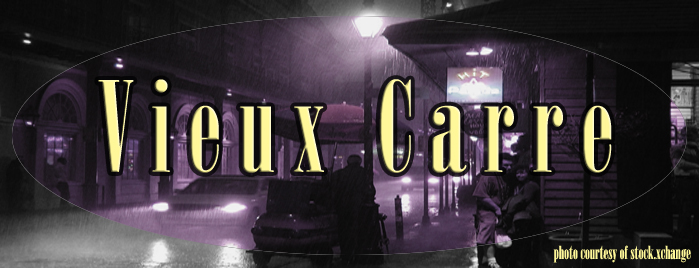
In a young, almost relentlessly Anglo-Saxon nation like the United States, the city of New Orleans feels exotic. The “Big Easy” remains Other, somehow not American, not one-of-us. Yet still definitely us. A contradiction or a living piece of irony. Male and female, American yet somehow European, French at the same time English-speaking.
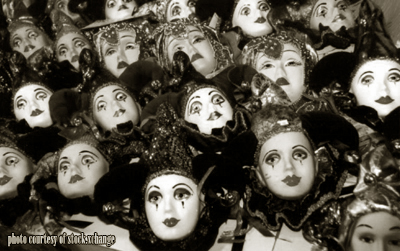
New Orleans endures, even thrives as quite simply, a masquerade.
Small wonder the gay/lesbian/transgender/bisexual community find this place a kind of home. It too survives as an outsider, a modern metropolis with a 19th century core. A once-major port now fading away but whose population more than triples from tourists each year as Mardi Gras (“Fat Tuesday”) begins. That celebration captures much of this city. When one looks deep, past the parades and parties and jazz festivals, Mardi Gras for generation after generation also served as a grand ceremonial for the quasi-secret Krewes . Many such do little more than contribute to the parades or provide excuses for friends or co-workers to hang out. But others, the oldest and most grand of all, consisted of the city’s elite. Imagine if you will all the secrecy of the most mysterious of college fraternities— Skull and Bones for example—with all the pomp, ceremony and grandeur of a High Catholic Mass . Then turn the whole thing into a masked ball with hints of the Freemasons . Now you have the Krewes.
Even so, this remains just one aspect of a multifaceted gem. Recall the city has its skyscapers! It remains a bastion of the oil industry. Despite the barred prison portrayed in the Cat People re-make, its large public zoo is in many ways state-of-the-art. Yet in walking distance of steel and glass towers glowing with electric light, one finds cobblestones, fountained courtyards and Voodoo shrines.
Novelist Anne Rice grew up here. For many decades she lived within its city limits and fans still hold yearly balls in honor of her characters. Her first novel, Interview With the Vampire , takes place here. So too does her third, Feast of All Saints . This latter delves into another area where New Orleans steers away from the mainstream. Near the vieux carre (the French Quarter ) two subcultures met, the so-called quadroon balls wherein lovely young women of the gens de couleur libres (“Free People of Color”) sought to entice white American aristocrats, forging relationships intended to last decades. Children of such unions, while technically illegitimate, often ended up quite well off. Families in the gens often owned plantations and slaves. Miscegenation, outlawed in the Deep South for generations, here became an institution with its own courtesies, its honor, its respected place in the scheme of things. Sexual variation often found a home in this city surrounded by swamp and death, full of life and color.
Tennessee Williams naturally set A Streetcar Named Desire here. Well, with a title like that where else could it take place? Really? Where else might such a brutish hulk like Stanley worship his wife Stella, or come into such specific conflict with his fragile, delusional, subtly predatory sister-in-law Blanche? The sexual tension of that play became something of an avatar for the city as a whole. Quite properly. In Angel Heart where else might a man learn he’s shared a girl with none other than the Devil himself? James Bond might have faced many a super-criminal but how many of them pretended to be a god? The one he faced in New Orleans!
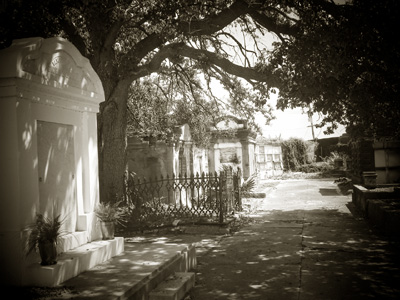
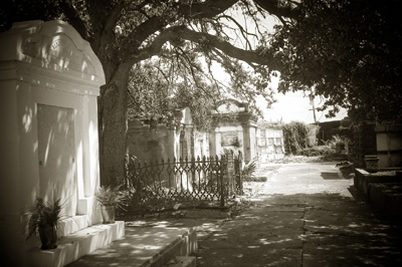
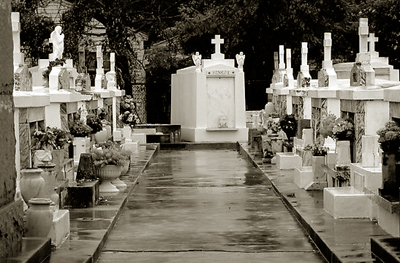
For those of us who’ve been there, New Orleans becomes a kaleidoscope of senses in our memory. The smell of chicory. Feeling the damp heat everywhere (my brother encourages people to imagine a wet invisible blanket placed over your head when arriving). Ah, the taste of beignet donuts ! Echoes in the alleyway next to St. Louis Cathedral , where duelists once fought. Music at night, fading in and out as one walked along Bourbon Street. Cayenne pepper in the air. Wrought iron. Red brick. Squalor and magnificence almost hand-in-hand (in most of America they tend to end up strictly segregated). Shadows even in the brightest day—shadows in alleys and dimly lit homes, amid the trees and inside above-ground tombs, amid those narrow streets. A place to celebrate and a place to hide. A place where one can be oneself in plain sight, by wearing a mask or a costume and pretending to be—who else? Yourself.
Maybe that is why when we think on New Orleans what we imagine remains the French Quarter. The oldest part of the city, hence the highest and in many ways least damaged by Katrina . New Orleans’ beating heart. Where we can be free, a least a little bit, for a time anyway.
Website design by David MacDowell Blue